Piazza Navona: Bernini's fountain on a Roman racetrack
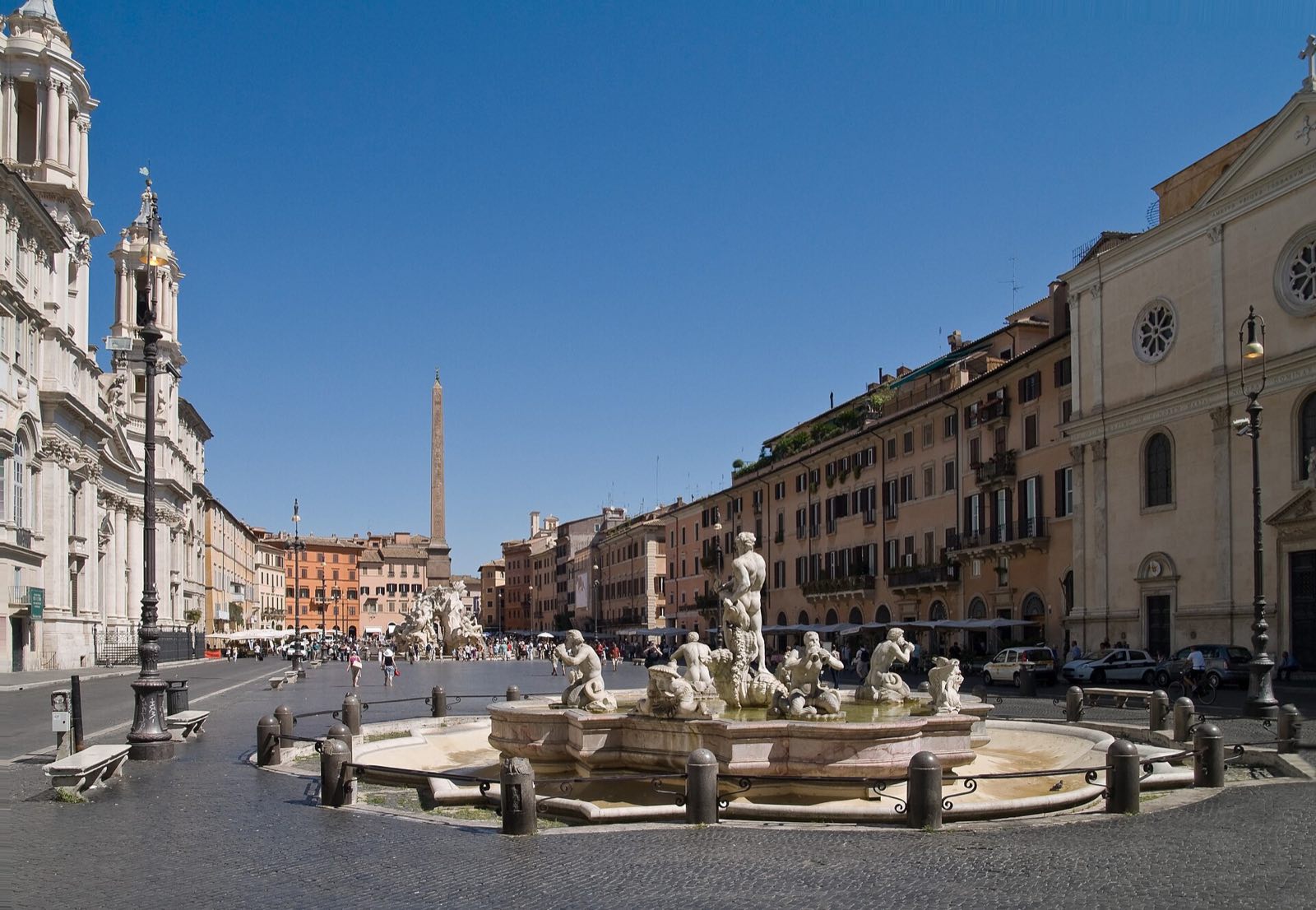
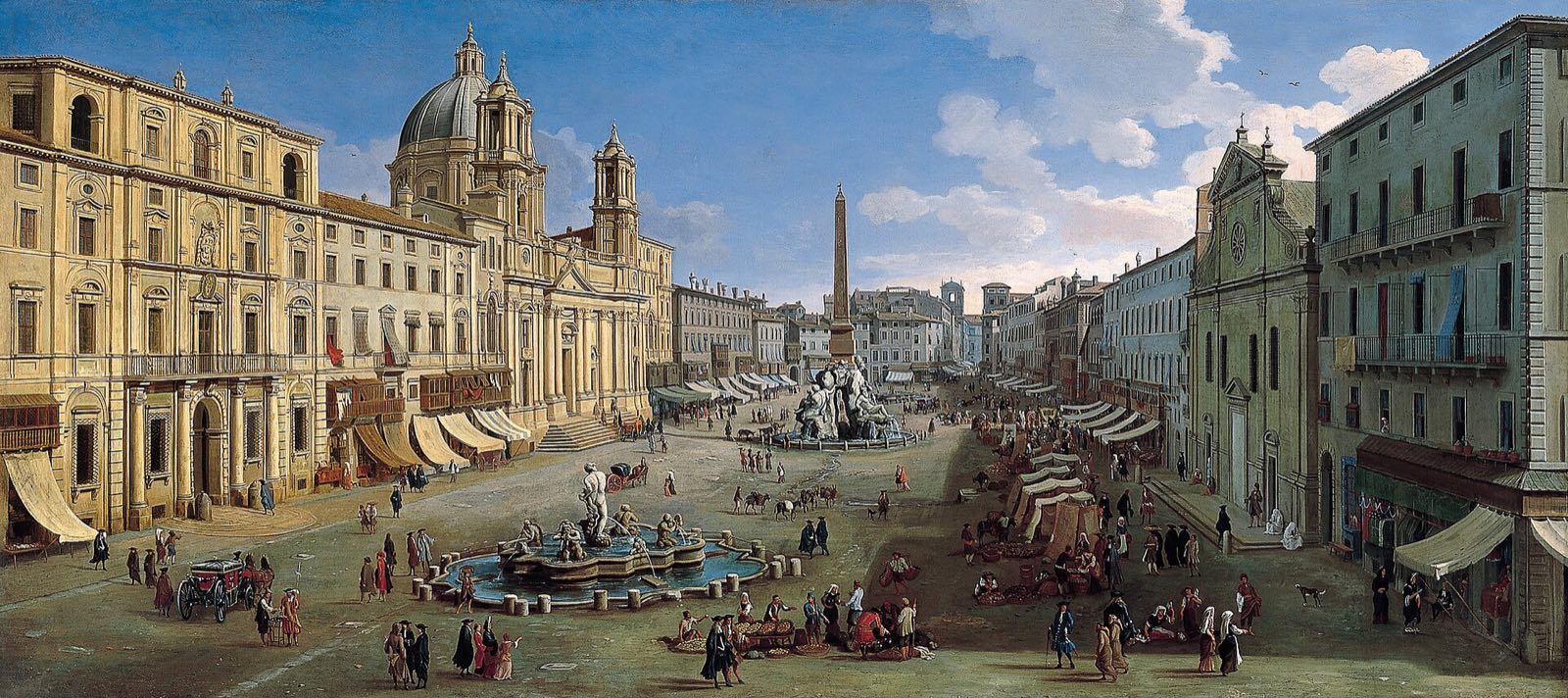
Piazza Navona is long, narrow and rounded at one end because it was a stadium first. The houses stand where the seats were.
- What it is
- Walk
- Time to allow
- 30 to 60 minutes
- Cost
- Free
- Best time
- Early morning, or after dinner
Rome this week
Why Piazza Navona is worth it
The emperor Domitian built a stadium here in the first century for athletic contests, the agones that gave the square its name. When it fell into ruin, houses were built on the banks of seats and the track was left open. The outline never changed, and you can still see part of the ancient stadium below street level at the northern end.
The square you see is the work of one pope. Innocent X, who reigned from 1644 to 1655, had his family palace here, and he turned his front yard into a showpiece. He gave the church to Borromini and the central fountain to Bernini, who did not like each other, and they faced one another across the paving for good.
It is still used as a square should be: painters, café tables, children, a toy market at Christmas. Nothing in it needs a ticket.
What to see
The Fountain of the Four Rivers
Bernini's fountain of 1651: four river gods, the Nile, the Danube, the Ganges and the Río de la Plata, for the four continents then known, round a rock that carries an Egyptian obelisk on what looks like thin air.
Sant'Agnese in Agone
The church facing the fountain. Its curved front is by Borromini. Entry is free. The story that Bernini's river god is shielding his eyes from it is too good to be true: the fountain came first.
The two end fountains
The Moor at the south end and Neptune at the north. The basins are sixteenth-century, by Giacomo della Porta. The Neptune was added only in 1878, to match.
The Stadium of Domitian
Under the houses at the north end, the arches of the Roman stadium survive some metres below today's street, and can be visited.
How to do it well
- Come before nine to have the fountains to yourself, and again after dark when they are lit.
- Have your coffee one street back. The tables on the square charge for the view.
- The Pantheon is five minutes east, Campo de' Fiori five minutes south. All three fit in one easy walk.
- Caravaggio's three St Matthew paintings are two minutes away, in San Luigi dei Francesi, and cost nothing to see.
- In December and early January the square fills with the stalls of the Befana market.
Where it is
Address
Piazza Navona, in the historic centre
Nearest station
No metro nearby. Buses stop on Corso del Rinascimento, beside the square
Museums and sights nearby
- Pantheon300 m
- Castel Sant'Angelo700 m
- Trevi Fountain850 m
- Capitoline Museums1.1 km
Distances are in a straight line.
Tickets and tours: Piazza Navona
Piazza Navona: common questions
- Why is Piazza Navona that shape?
- It stands on the Stadium of Domitian, built in the first century. The buildings round the square rose on the ruins of the seating, so the open space kept the long oval of the track.
- Who made the fountain in Piazza Navona?
- The central one, the Fountain of the Four Rivers, was designed by Gian Lorenzo Bernini in 1651 for Pope Innocent X. The basins of the two at the ends are by Giacomo della Porta.
- Is Piazza Navona free?
- Yes. It is a public square, open at all hours, and the church of Sant'Agnese in Agone is free to enter too.
- How much time do you need for Piazza Navona?
- Allow 30 to 60 minutes. That is this site's estimate for an unhurried visit.
What visitors say about Piazza Navona
Rating from Google
Things to do near Piazza Navona
The nearest of this site's best things to do in the city. Distances are in a straight line.
- 20Find Caravaggio's paintings in three churches150 m awayChurch, 1 to 2 hours, free
- 4Stand under the dome of the Pantheon300 m awayMonument, 30 to 45 minutes, ticket
- 13Eat your way from Campo de' Fiori to the Ghetto400 m awayWalk, 1.5 to 2.5 hours, free
- 10Go up Castel Sant'Angelo700 m awayMonument, 1.5 to 2 hours, ticket
Hotels near Piazza Navona
The five-star hotels closest to it, of those this site lists in Rome. Distances are in a straight line.
- Hotel Raphaël4.5Five-star hotel, Piazza Navona100 m away
- Orient Express La Minerva4.5Five-star hotel, Pantheon400 m away
- J.K. Place Roma4.8Five-star hotel, Via del Corso650 m away
- Six Senses Rome4.6Five-star hotel, Via del Corso700 m away